
Derek H.'s Counterfeit Bills: A Dark Web Scheme Gone Awry
Derek H. from Denver bought fake 100 dollar notes on a darknet marketplace in January 2025 and tried to deposit them via ATMs, yet the scheme collapsed after the bank froze his account and the Secret
Written: · 3 min
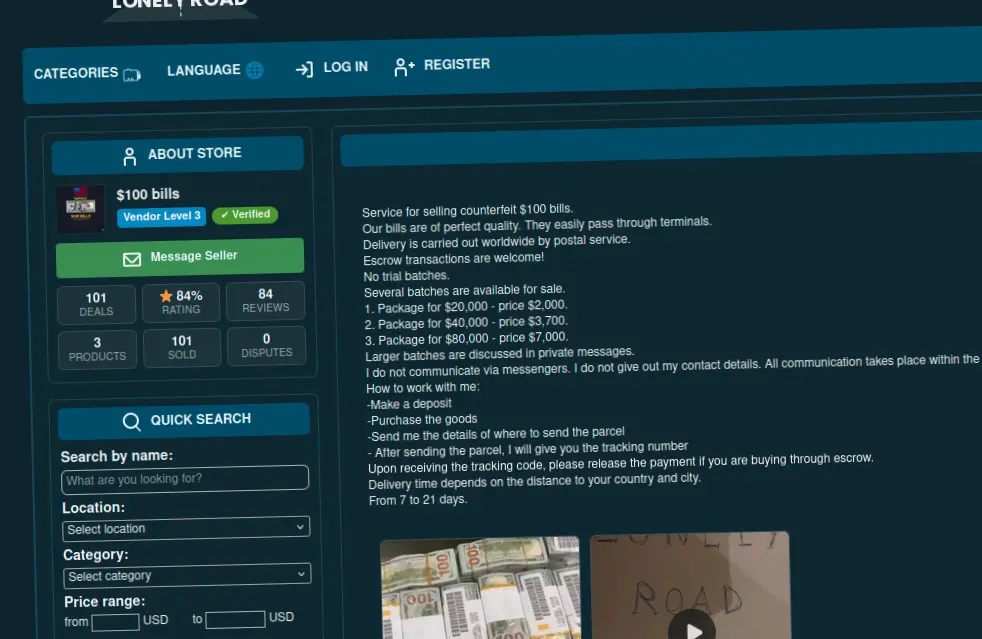
Many believe that counterfeit $100 dollar bill deposits through cash-accepting ATMs offer an easy path to convert fake money into legitimate balances. This claim requires careful examination because banks employ layered verification that often detects anomalies. The case of a 29-year-old Colorado resident demonstrates how such attempts unfold and why they frequently fail despite seller promises of superdollar quality.
1. The Purchase on the Darknet
In 2025, during January, a man aged 29 named Derek H. from Denver secured 40 fake $100 notes from the 2009 series. Using $1,200 in cryptocurrency, this transaction was completed on a darknet marketplace. The seller assured him that the bills were of high quality, featuring security elements akin to genuine currency, including UV protection and magnetic strips. Derek planned to insert these counterfeit notes into an ATM, under the impression that the machine would process them without issues. Nevertheless, his subsequent attempts revealed significant challenges, highlighting the risks associated with counterfeit money.
2. The ATM Deposit Attempts
Derek initiated his plan by attempting to use counterfeit dollar bills at ATMs that allow cash deposits. His first two transactions were successful, adding $800 to his bank account. The third ATM malfunctioned, leading to complications as one of the bills was rejected. A bill was accepted by the fourth machine, but the transaction was flagged for further examination. These discrepancies suggested possible variations in the operational standards of the ATMs he used. Derek expected that the funds would soon be accessible for withdrawal or transfer. His goal was to convert the counterfeit money into legitimate funds, which ultimately drew the attention of the bank.
3. Bank Response and Investigation
The next day, the financial institution restricted Derek's account following the identification of unusual transactions. After a period of three weeks, officials from the U.S. Secret Service took him into custody. The bank deciphered the fraudulent operation by utilizing a mix of automated monitoring and human analysis. Although the seller promoted realistic characteristics, the forged $20 bills, along with higher denominations, still exhibited noticeable flaws when examined closely. Financial institutions do not depend entirely on ultraviolet or magnetic tests conducted by ATMs. Further verification measures are implemented after the initial acceptance of the bills. This is particularly true when a significant volume of similar notes is deposited in a brief timeframe. Such outcomes align with patterns observed in many cases involving counterfeit currency acquired online.
Final Assessment
The Denver incident illustrates that using counterfeit money at ATMs poses a significant risk of being caught. Financial institutions utilize advanced systems that not only validate currency physically but also analyze transaction trends that are not obvious to the average user. While some individuals may believe they can use materials marketed as prop money for sale nearby, the effectiveness of this method is inconsistent. Law enforcement agencies closely track such illegal activities. Those who attempt this can expect serious legal repercussions. The counterfeit $100 bill involved in this case did not pass through the entire verification process successfully. Similar failures have been noted with attempts to use fake $20 bills. The money spent on counterfeit currency through darknet platforms did not yield positive results. Future attempts to leverage fake money services are likely to face similar challenges.
The transaction originated from the website where the purchase was made.
Common questions
- How much did Derek pay for the counterfeit bills?
Derek paid $1,200 in cryptocurrency for 40 counterfeit $100 bills. This equals $30 per note. The price reflected the seller's claim of superdollar quality.
- Did all ATMs accept the fake money?
The first two ATMs accepted the bills and credited $800. The third returned a bill with an error. The fourth accepted one but flagged the transaction as pending review.
- What agency arrested Derek H.?
The U.S. Secret Service arrested him three weeks after the bank froze his account. The investigation followed standard procedures for counterfeit currency cases.
- What features did the seller promise for the notes?
The seller promised visually indistinguishable quality with working UV protection, magnetic strip, and watermark. These features are common in descriptions of 100 dollar fake money sold online.